
Brevard County's largest city
Asphalt Paving in Palm Bay, FL
Paving for a city of long streets, open swales and thousands of platted lots.
- No-cost estimates at your property
- Line-item written quotes
- Swale and culvert drainage reviewed first
Paving Across Palm Bay's Quadrants
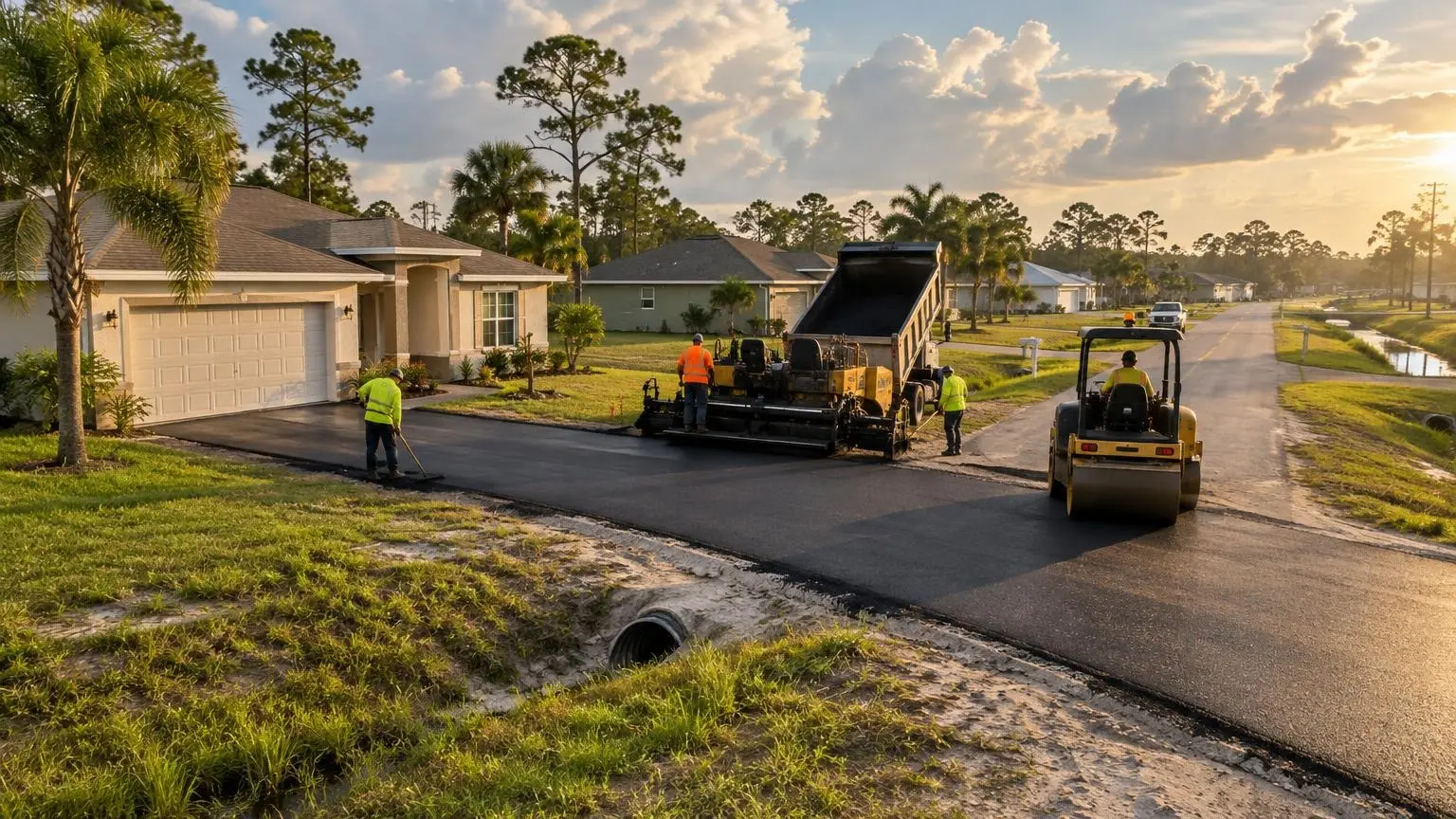
Asphalt paving in Palm Bay covers a city that is unusually large and unusually young. Palm Bay incorporated on January 16, 1960, with 2,808 residents. By 2020 it had 119,760 people on more than 86 square miles of land, making it the most populous city in Brevard County and the largest by area. Most of that growth came on lots laid out by General Development Corporation, which bought and platted large tracts for its Port Malabar project starting in 1959.
A city built on drained land
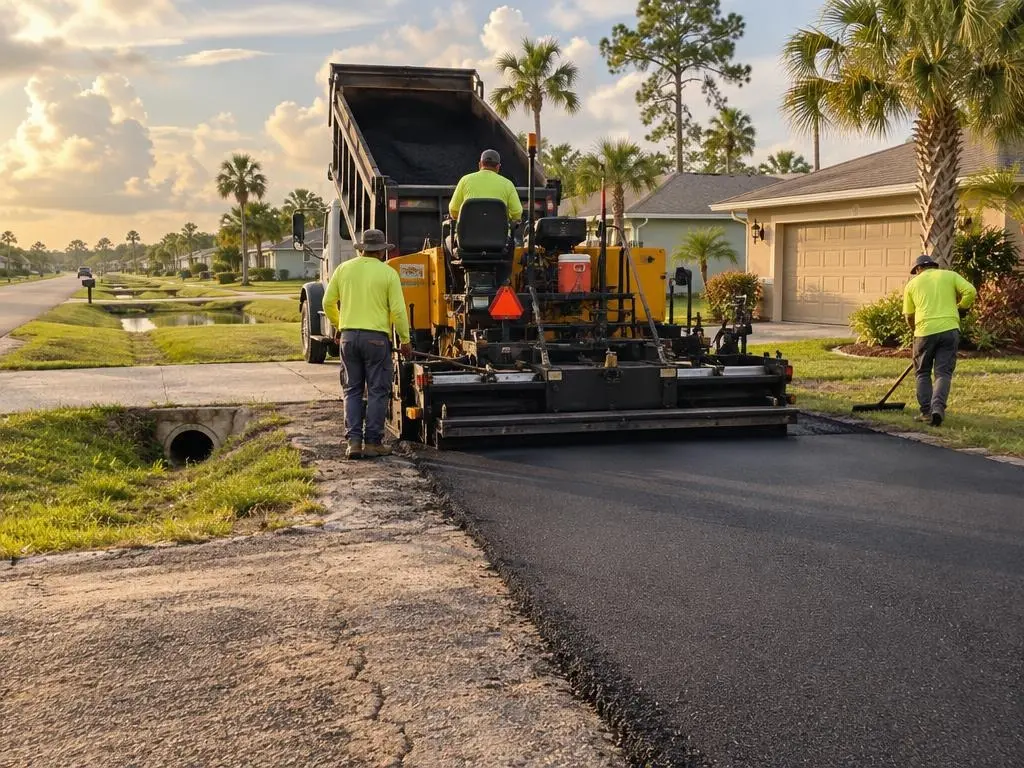
Before the lots, there was swamp. In the 1920s, a drainage district dug 80 canals totaling about 180 miles to drain roughly 40,000 acres. That canal and swale system still carries the city's stormwater. For a driveway, it means water has to reach the roadside swale and pass through the culvert under your apron. Blocking that path, even by an inch, leaves water standing in the yard or on the drive.
Roads, paved and not
The city maintains about 851 miles of roads, and most roads west of DeGroodt Road are still unpaved. In 2013, the public works director described most roads in south Palm Bay as failed roads. After several funding measures failed, voters approved a $150 million general obligation bond in 2018 for citywide road repair, and construction began in August 2019 on a plan that works through the city's four quadrants. Many homeowners decide to redo their driveway around the time their street is rebuilt.
Rain by the month
Palm Bay averages 55.55 inches of rain a year. September is the wettest month at 7.95 inches, followed by June at 7.62 and August at 7.11; December is the driest at 2.46. In November 2023, 11 inches fell on the city in one event, with unofficial totals near 20 inches in southern Palm Bay, and the city was among the hardest hit by flooding. We schedule paving and sealing with those patterns in mind.
Where we work in Palm Bay
- Northeast and northwest neighborhoods off Palm Bay Road and Port Malabar Boulevard
- Southeast streets near Malabar Road and the historic area at Turkey Creek
- Southwest Palm Bay, where many streets and driveways are still unpaved
- Commercial lots along Malabar Road, Palm Bay Road and Babcock Street
- New neighborhoods near the St. Johns Heritage Parkway
Permits and the right-of-way
The apron over the swale sits in the public right-of-way. If your project changes the apron, the culvert or anything at the street, we confirm with the City of Palm Bay what is required before scheduling. We do not guess at permit rules; we check them for your address.
Typical Palm Bay jobs
The most common are full driveway replacements on homes from the GDC era, shell or dirt drives paved for the first time, driveway widening, resurfacing worn drives, sealcoating, and repairs at the swale edge. Each estimate starts with the drainage.
GDC-era homes
Many Palm Bay homes were built in the 1970s through the 1990s, and plenty still have their original driveway or a single overlay on it. Asphalt of that age has usually dried out and cracked, and the base may have settled near the apron. We check both before recommending resurfacing or replacement.
What to Know in Palm Bay
- Incorporated 1960. Palm Bay incorporated on January 16, 1960, with 2,808 residents; the 2020 census counted 119,760.
- Port Malabar platting. General Development Corporation bought and platted large tracts for the Port Malabar residential project starting in 1959.
- Canals. In the 1920s a drainage district dug 80 canals totaling 180 miles to drain about 40,000 acres of swampland.
- Road bond. Voters approved a $150 million road bond in 2018; work began in August 2019 on an eight-year plan by quadrant. Most roads west of DeGroodt Road are unpaved.
- Rainfall. Average annual precipitation is 55.55 inches; September averages 7.95 inches and December 2.46.
Palm Bay Questions
Should I redo my driveway when the city rebuilds my street?
It is often a good time. The new road surface and apron set the height your driveway needs to meet, and doing both close together avoids a mismatched joint at the street.
Why does water stand at the end of my driveway?
Usually the culvert under the apron is clogged, crushed or set too high, or the swale has filled in. We check it at the estimate and tell you what is causing it.
Do you pave in southwest Palm Bay where the streets are dirt?
Yes. Many driveways there are shell or dirt. We pave them with a raised, compacted base so they shed water and hold up.
Asphalt Paving Near Palm Bay
- Asphalt Paving in Melbourne, FL
- Asphalt Paving in West Melbourne, FL
- Asphalt Paving in Malabar, FL
- Asphalt Paving in Grant-Valkaria, FL
- Asphalt Paving in Sebastian, FL
- Asphalt Paving in Micco, FL
- Asphalt Paving in Barefoot Bay, FL
- Asphalt Paving in Melbourne Beach, FL
- Asphalt Paving in Indialantic, FL
- Asphalt Paving in Satellite Beach, FL
- Asphalt Paving in Indian Harbour Beach, FL
- Asphalt Paving in Rockledge, FL
- Asphalt Paving in Viera, FL
- Asphalt Paving in Cocoa, FL
- Asphalt Paving in Cocoa Beach, FL
- Asphalt Paving in Fellsmere, FL
- Asphalt Paving in Vero Beach, FL
- Asphalt Paving in Palm Shores, FL
- Asphalt Paving in Port St. John, FL